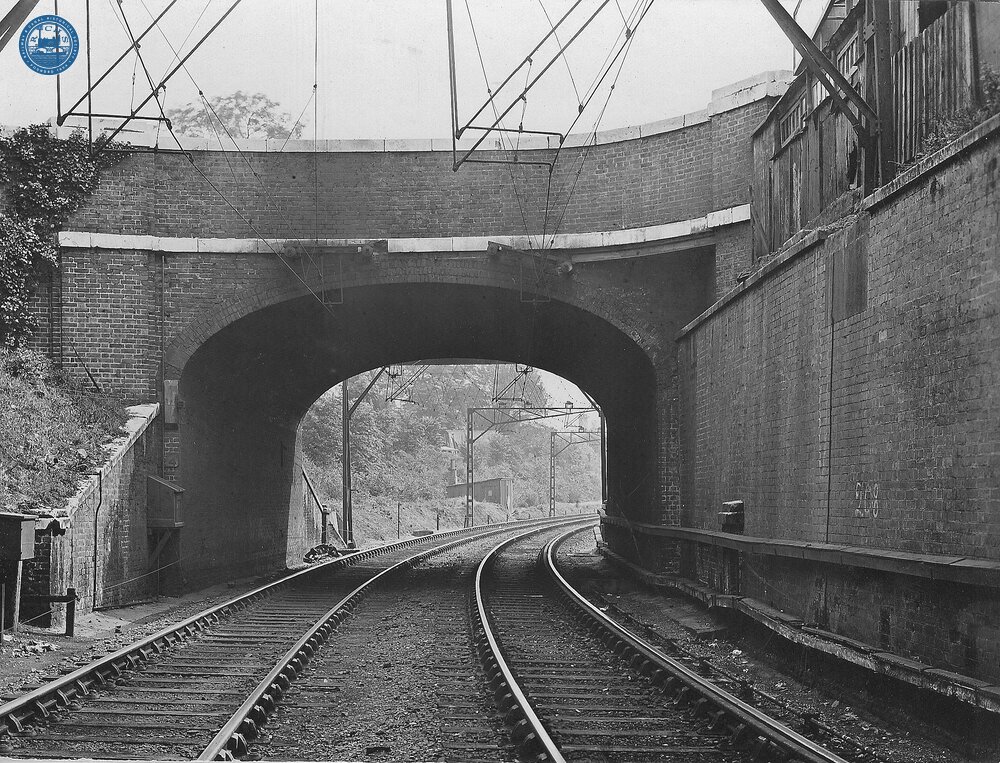
West Croydon, Spurgeon’s Bridge (formerly Croydon Canal, now NFE @ 10m 15ch. and currently known as St. James’s Bridge). Circa 1923
Spurgeon's Bridge is about ¼ mile north-east of West Croydon station. Another photograph taken from the other side of the bridge, and perhaps on the same day, was published in the Southern Railway Magazine in 1923. It is currently known as St. James’s Bridge, after the road it carries. J T Howard Turner, in his history of the LBSCR (Vol 1 1977), records that the railway was constructed on the alignment of the Croydon Canal, but only Spurgeon’s bridge had sufficient width and clearance to accommodate trains: “ the last bridge at the Croydon end remained unaltered except for being widened in reinforced concrete on the London side. It has for many years now been called Spurgeon’s bridge, and less frequently Tabernacle bridge, as the West Croydon Baptist Church [built in 1873 and known as Spurgeon’s Tabernacle by Croydonians] is immediately adjacent to the bridge; another name for it is the Canal bridge. The brick arch on the station (or country) side of the bridge is original, and dates from about 1808; the London-side widening was done in 1928.” Installation of overhead line electrification equipment had commenced prior to World War 1, nominally as far as Beeches Halt, but was suspended by the War. Charles Haddon Spurgeon was a 19th Century Baptist preacher, theologian and educator. Further information may be found online.
ROMA ID: 030553E